WHAT IS TRUST WALLET IN CRYPTO: Think of Trust Wallet as a digital safe for your cryptocurrencies. It’s an app that allows you to store, send, and receive a wide variety of cryptocurrency (like Bitcoin, Ethereum, etc.) all in one place, directly on your smartphone.
What makes Trust Wallet unique is that it’s a “self-custody” wallet. This means YOU are in charge of your private keys (which are like your wallet’s password), unlike using an exchange where they hold the keys for you. This gives you full control over your crypto, without relying on third parties.
It also supports decentralized apps (dApps) and even allows you to interact with DeFi (Decentralized Finance) platforms, enabling you to trade and invest directly from your wallet.
So, Trust Wallet is all about keeping your assets secure and giving you easy access to a wide range of crypto-related services, all while keeping control in your hands.
Trust Wallet was created by Victor Radchenko, a software developer, in 2017. Initially, he built the wallet as a personal project to address his frustrations with using other wallets that were often slow or difficult to use. His goal was to create an easy-to-use, secure, and versatile wallet for managing various types of cryptocurrencies.
In 2018, Trust Wallet was acquired by Binance, one of the largest cryptocurrency exchanges in the world. After the acquisition, it continued to grow and evolve, adding more features and support for additional cryptocurrencies and decentralized applications (dApps).
Aspect
Details
Name
Trust Wallet
Creator
Victor Radchenko
Year of Creation
2017
Core Function
decentralized app
Supported
IOs and Android
Accessibility
Free download and use,
What are the benefits of Trust Wallet?
Trust Wallet offers several key benefits that make it a popular choice for managing cryptocurrencies and interacting with decentralized apps (dApps). Here are some of the main advantages:
1. Full Control Over Your Funds
Since Trust Wallet is non-custodial, you control your private keys and funds. This means you have full ownership of your crypto assets, unlike centralized exchanges where the exchange holds your private keys. This reduces the risk of hacking or losing funds due to a breach on a third-party platform.
2. Wide Range of Supported Cryptocurrencies
Trust Wallet supports over 160,000 cryptocurrencies, including major coins like Bitcoin, Ethereum, Binance Coin (BNB), and a wide variety of tokens (ERC-20, BEP-2, BEP-20, ERC-721 for NFTs, etc.). This makes it a versatile wallet for managing multiple types of digital assets in one place.
3. Decentralized Finance (DeFi) Access
With Trust Wallet, you can access the world of DeFi (Decentralized Finance) directly from your phone. The wallet integrates with decentralized exchanges (DEXs), lending platforms, yield farming, and other DeFi services, allowing you to participate in these ecosystems without needing to use centralized services.
4. Built-In dApp Browser
Trust Wallet comes with a Web3 browser, enabling you to interact with dApps (decentralized applications), including NFT marketplaces, decentralized exchanges, and even blockchain-based games. This allows you to access a variety of services directly from the app without needing an additional browser or extension.
5. NFT Support
Trust Wallet lets you manage NFTs (non-fungible tokens), allowing you to store, send, and receive these digital collectibles. It supports popular NFT standards like ERC-721 and ERC-1155, giving you access to the growing world of digital art, gaming items, and collectibles.
6. Staking Rewards
Trust Wallet allows you to stake certain cryptocurrencies, earning passive income in the form of staking rewards. Coins like Tezos, Tron, and Cosmos can be staked directly from the wallet, allowing you to participate in proof-of-stake (PoS) networks and earn additional tokens over time.
7. Easy Backup and Recovery
Trust Wallet provides a 12-word recovery phrase during the setup process. This makes it easy to recover your wallet and restore access to your funds in case you lose your phone or need to reinstall the app. It’s a simple and secure way to ensure you never lose access to your assets.
8. Security and Privacy
Trust Wallet prioritizes security by storing your private keys locally on your device (encrypted), rather than on a centralized server. The app also has various features like biometric authentication and PIN protection, ensuring your wallet remains secure. Plus, since it’s non-custodial, your personal information and transaction history are kept private, unlike many centralized services that may require KYC (Know Your Customer).
Trust Wallet is free to use. There are no wallet fees for creating, using, or managing your wallet. The only fees you pay are the network transaction fees (the same fees you would pay on the blockchain when making a transaction), which are standard and go to the respective blockchain networks, not to Trust Wallet.
10. Cross-Platform Support
Trust Wallet is available on both iOS and Android, making it accessible to a wide range of users. Whether you’re using an iPhone or an Android phone, you can enjoy the same features and functionality on both platforms.
11. Open-Source and Transparent
Trust Wallet is open-source, which means anyone can review the code, contribute to the project, and verify that the wallet is secure. This transparency helps build trust within the crypto community, as users can be confident that the app isn’t hiding any vulnerabilities or malicious code.
12. User-Friendly Interface
Trust Wallet has a clean and intuitive user interface, making it easy for beginners to navigate and manage their crypto assets. Whether you’re sending, receiving, or swapping tokens, everything is designed to be straightforward and simple.
13. Multi-Language Support
The wallet supports several languages, making it accessible to users around the world. This is especially important as the crypto space continues to grow globally.
To sum up:
Trust Wallet gives you complete control, high security, and access to the expansive world of decentralized finance, NFTs, and dApps. Its user-friendly design and low fees, along with support for a wide range of cryptocurrencies and staking options, make it an excellent choice for both newcomers and seasoned crypto users.
What are the disadvantages of trust wallet
While Trust Wallet offers a lot of benefits, there are also a few disadvantages that users should be aware of:
1. No Desktop Version
Trust Wallet is only available as a mobile app for iOS and Android devices. There’s no desktop version or web interface for managing your funds, which can be a limitation for users who prefer managing their crypto from a computer. If you’re used to using wallets like MetaMask on a desktop, this could be a downside.
2. Not Suitable for Beginners Without Crypto Knowledge
Although Trust Wallet is relatively user-friendly, it’s still primarily designed for people who already have a basic understanding of how cryptocurrencies work. Beginners might find it a bit confusing to set up, especially when it comes to managing private keys, dealing with gas fees, or interacting with decentralized applications (dApps).
3. Lack of Customer Support
As a non-custodial wallet, Trust Wallet doesn’t provide customer support in the traditional sense. Since you’re in control of your private keys and funds, if you lose your recovery phrase or have trouble with your wallet, you can’t easily contact a support team for assistance. This can be stressful if you’re not fully aware of how to back up or restore your wallet.
4. Transaction Fees
While Trust Wallet itself doesn’t charge any fees for using the app, you’ll still have to pay network fees (also known as gas fees) for each transaction you make, whether you’re sending crypto or interacting with a decentralized exchange (DEX). These fees can fluctuate and may be quite high during periods of network congestion (e.g., Ethereum gas fees can be very expensive).
5. Limited Advanced Features
For more experienced users who are looking for advanced trading tools or integrations with professional trading platforms, Trust Wallet may feel a bit basic. It doesn’t offer things like limit orders, advanced charting, or margin trading, which are available on centralized exchanges or more specialized wallets.
6. No Built-In Exchange for Fiat-to-Crypto Conversion
While Trust Wallet integrates with some decentralized exchanges (DEXs) and allows you to swap cryptocurrencies, it doesn’t support fiat-to-crypto conversions directly within the wallet. If you want to buy crypto using traditional money (USD, EUR, etc.), you’ll need to use another platform like Binance or a different exchange first, and then transfer the crypto to your Trust Wallet.
7. Backup Risks
Trust Wallet relies heavily on the 12-word backup phrase for restoring access to your wallet. This means that it’s crucial to store your backup phrase securely and privately. If you accidentally share it or store it in an insecure location, someone else could gain access to your wallet.
Trust Wallet doesn’t support multi-signature wallets (which require more than one private key to authorize a transaction). Multi-signature features are often used by businesses or users who want an extra layer of security to ensure that multiple parties have to approve transactions. If you’re looking for this type of feature, Trust Wallet might not meet your needs.
9. Limited Exchange Features
While Trust Wallet integrates with decentralized exchanges like 1inch and PancakeSwap, it doesn’t offer the full range of features you’d expect from a centralized exchanges like Binance or Coinbase. For example, there’s no built-in order book or price charts for real-time trading. This limits the functionality for traders who want a more comprehensive trading experience.
10. Risk of Mobile Vulnerabilities
Being a mobile-only wallet means your Trust Wallet is only as secure as your phone. If your phone is compromised (e.g., through malware or a lost device), your private keys and funds are at risk. It’s important to use phone security measures (e.g., strong passwords, biometric authentication) to mitigate this risk.
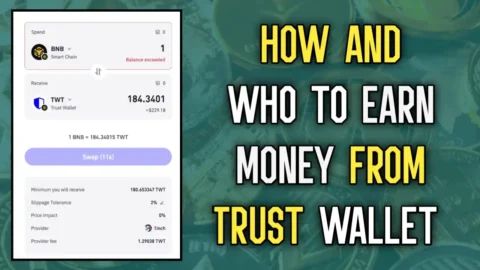
How and who to earn money from Trust Wallet
There are several ways to earn money using Trust Wallet, mostly through features like staking, DeFi (Decentralized Finance), and NFTs (Non-Fungible Tokens). Here’s how you can earn money from Trust Wallet:
1. Staking Cryptocurrencies
Who Can Earn: Anyone with supported cryptocurrencies in Trust Wallet. How to Earn:
Staking involves holding and locking up certain cryptocurrencies to participate in a blockchain network’s proof-of-stake (PoS) consensus mechanism. By doing so, you help secure the network and, in return, earn staking rewards (a percentage of newly minted coins).
Trust Wallet supports staking for a number of coins like Tezos (XTZ), Tron (TRX), Cosmos (ATOM), Binance Coin (BNB), and others.
You can stake your crypto directly within the Trust Wallet app by following these steps:
Open the app and select the cryptocurrency you want to stake.
Choose the “Stake” option.
Select the staking provider (validator) and the amount you want to stake.
Confirm and wait for the rewards to accumulate.
2. Yield Farming and Liquidity Pooling (DeFi)
Who Can Earn: Anyone who is familiar with or willing to learn about decentralized finance (DeFi) protocols. How to Earn:
Yield farming involves providing liquidity (funds) to decentralized exchanges (DEXs) or liquidity pools. In exchange, you earn interest or a portion of the transaction fees generated by the pool.
Trust Wallet integrates with DeFi platforms such as PancakeSwap (on Binance Smart Chain) or Uniswap (on Ethereum), where you can participate in liquidity pools.
By connecting Trust Wallet to these platforms, you can provide liquidity in the form of token pairs (e.g., BNB and USDT) and earn a share of the fees generated from trades that occur in the pool. Some platforms also offer incentives, such as liquidity provider (LP) tokens that can be staked further for additional rewards.
Risks: Be aware of potential impermanent loss (where the value of your staked tokens changes relative to each other) and platform vulnerabilities.
3. Swap Tokens for Profit
Who Can Earn: Anyone who has an understanding of the cryptocurrency market and is willing to take on risk. How to Earn:
Trust Wallet has an in-built token swap feature that lets you exchange one cryptocurrency for another without leaving the wallet.
You can buy low and sell high by swapping tokens, especially if you’re following market trends and trading on decentralized exchanges (DEXs) integrated with Trust Wallet.
You may need to connect Trust Wallet to a decentralized exchange (DEX) like 1inch or PancakeSwap to get access to more tokens and take advantage of price fluctuations.
4. Participate in Initial DEX Offerings (IDOs)
Who Can Earn: Anyone who is willing to take the risk and has access to specific IDO platforms. How to Earn:
Some projects offer Initial DEX Offerings (IDOs) where you can invest in new tokens before they are publicly traded on major exchanges.
Trust Wallet supports IDOs on platforms like PancakeSwap or Polkastarter, where you can participate in token sales.
The idea is to buy the tokens early at a low price and sell them when their value increases once they are listed on exchanges.
Risks: Participating in IDOs can be risky, as there is no guarantee the project will succeed. The price may drop after launch, leading to potential losses.
5. NFT Trading and Selling
Who Can Earn: Anyone with an interest in NFTs (Non-Fungible Tokens) and access to platforms that sell and auction NFTs. How to Earn:
Trust Wallet supports NFTs (ERC-721 and ERC-1155), which are unique digital assets typically used for digital art, collectibles, and gaming.
You can buy, sell, and trade NFTs directly within the Trust Wallet app or on NFT marketplaces such as OpenSea, Rarible, or Binance NFT Marketplace.
If you create or hold valuable NFTs (like digital art, collectibles, or in-game items), you can potentially sell them for a profit.
To sell NFTs:
Connect your Trust Wallet to an NFT marketplace.
List your NFTs for sale or auction.
Wait for a buyer or auction winner, and then transfer the NFT to them in exchange for cryptocurrency (like ETH or BNB).
6. Earning through Airdrops
Who Can Earn: Anyone who meets the criteria for specific airdrop campaigns. How to Earn:
Some blockchain projects distribute free tokens to users in what’s called an airdrop. Trust Wallet is often used as a wallet to receive such tokens.
To participate, you need to join the airdrop by following specific instructions, such as joining a Telegram group, following on Twitter, or completing certain tasks.
Once eligible, the tokens will be sent to your Trust Wallet address.
Risks: Airdrops can sometimes be a scam, so it’s essential to ensure that you’re participating in a legitimate project.
7. Referral Programs
Who Can Earn: Anyone who refers others to use Trust Wallet. How to Earn:
Some services or exchanges that integrate with Trust Wallet, like Binance or other DeFi platforms, may offer referral bonuses when you refer new users.
You can share your referral link with friends or followers, and if they sign up and make transactions, you can earn a bonus (often in the form of free crypto or a percentage of their trading fees).
To sum up:
Anyone with a Trust Wallet and some basic crypto knowledge can start earning money through various methods like staking, yield farming, token swaps, NFT trading, airdrops, and referral programs.
While these methods can offer substantial rewards, they also come with risks — such as market volatility, impermanent loss, and the possibility of scams (especially with DeFi or airdrop projects). It’s important to do your research and understand the risks involved before committing to any earning strategy.
How to start trading with Trust Wallet
To start trading with Trust Wallet, follow these simple steps:
Download Trust Wallet from the Google Play Store (for Android) or Apple App Store (for iOS).
Open the app and create a new wallet or import an existing wallet using your recovery phrase.
Set a secure PIN and enable additional security options like biometric authentication (fingerprint or face recognition).
2. Fund Your Wallet
Buy or transfer cryptocurrency to your Trust Wallet. You can purchase crypto directly from the app via third-party services or transfer funds from an exchange like Binance or CoinDCX by providing your wallet address.
3. Swap Tokens
Trust Wallet has a built-in token swap feature. To trade cryptocurrencies:
Open the app and tap on the “Swap” or “DEX” option.
Select the crypto pair you want to trade (e.g., BTC for ETH).
Enter the amount you want to trade and review the transaction details.
Confirm the transaction. You’ll need to pay the network fee for the trade.
4. Use Decentralized Exchanges (DEXs)
You can access decentralized exchanges like PancakeSwap or Uniswap through the built-in dApp browser.
Go to the dApp browser in Trust Wallet.
Connect to a DEX and choose the tokens you wish to trade.
Swap your tokens following the instructions and pay the associated network fee.
5. Check Prices and Market Trends
You can monitor market prices directly within Trust Wallet by using integrated price tracking tools or connecting to DeFi platforms that offer real-time price charts.
6. Keep Track of Your Trades
After completing your trade, check your wallet balance to ensure your new assets have been successfully received.
7. Withdraw or Transfer Funds
If you want to transfer the traded crypto to another wallet or exchange, simply use the Send feature in Trust Wallet and enter the recipient’s wallet address.
Tips:
Make sure to be aware of network fees (gas fees) when trading, as these vary depending on blockchain congestion.
Always verify token addresses and ensure you’re interacting with legitimate platforms to avoid scams.
By following these steps, you can easily begin trading crypto assets in Trust Wallet securely and efficiently!
Can we use trust wallet in india
Yes, you can use Trust Wallet in India! There are no specific restrictions on using Trust Wallet for managing cryptocurrencies in India. Since Trust Wallet is a non-custodial wallet, meaning you control your private keys, it operates independently of centralized exchanges or third-party platforms, which makes it available globally, including in India.
Key things to keep in mind:
Legal Status of Cryptocurrencies in India: The legal status of cryptocurrencies in India has been somewhat uncertain, with varying stances from regulators. However, the Indian government has not banned the use of cryptocurrencies, and there is still a growing interest in digital assets. Just be aware that there have been discussions around potential regulations and taxation related to cryptocurrencies.
Using Trust Wallet in India:
You can download Trust Wallet on your Android or iOS device from the respective app stores.
You can store, send, and receive a wide range of cryptocurrencies.
You can also interact with DeFi platforms, dApps, and NFTs (non-fungible tokens) using Trust Wallet.
Buying Crypto in India: While Trust Wallet can be used to store and manage cryptocurrencies, to actually buy crypto in India, you would need to use a crypto exchange. Some popular exchanges in India where you can purchase cryptocurrencies and then transfer them to Trust Wallet include:
WazirX
CoinDCX
ZebPay
Unocoin (for Bitcoin purchases)
Transferring Crypto to Trust Wallet: After purchasing crypto on an exchange, you can transfer your tokens to your Trust Wallet by providing your wallet address from Trust Wallet to the exchange. This allows you to securely store your crypto in your wallet instead of leaving it on an exchange.
Cryptocurrency Regulations:
Taxation: Cryptocurrencies are subject to taxation in India, especially if you’re trading them for profit. It’s essential to stay updated on the latest tax rules regarding crypto transactions.
Banking Issues: Some users in India have faced challenges with banks when trying to deposit or withdraw money from crypto exchanges. However, peer-to-peer (P2P) transactions and decentralized platforms like Trust Wallet can bypass these issues since it doesn’t require a bank for operations.
FAQs –
Q 1. What is Trust Wallet?
Answer –Trust Wallet is a non-custodial cryptocurrency wallet that allows you to securely store, send, receive, and manage a wide range of cryptocurrencies. It supports over 160,000 digital assets, including Bitcoin, Ethereum, Binance Coin, and NFTs. Trust Wallet is available on iOS and Android devices and includes features like staking, DeFi access, and an integrated dApp browser.
Q 2. What is the feature of Trust Wallet
Answer –Trust Wallet features include:
Cross-platform (iOS & Android)
Non-custodial (you control your private keys)
Multi-crypto support (160,000+ assets)
Staking for earning rewards
dApp browser for decentralized apps
NFT management (ERC-721 & ERC-1155)
Token swaps within the wallet
Security (encrypted private keys, backup phrase)
Q 3. Is it necessary to invest to earn money from Trust Wallet?
Answer – No, it’s not necessary to invest to earn money from Trust Wallet. You can earn through staking, airdrops, participating in DeFi (Decentralized Finance), or by trading NFTs. However, some methods like staking or DeFi may require initial investment in cryptocurrencies.
Q 4. What is the fee to be paid for trading in Trust Wallet?
Answer – There are no fees for using Trust Wallet itself. However, when trading or making transactions, you’ll need to pay network fees (also known as gas fees), which go to the blockchain network (e.g., Ethereum, Binance Smart Chain) for processing the transaction. These fees vary depending on the network’s congestion.
Conclusion :-
In conclusion, Trust Wallet is a versatile, secure, and user-friendly mobile wallet that allows you to manage a wide range of cryptocurrencies and digital assets. With features like non-custodial security, support for over 160,000 assets, staking, DeFi access, and NFT management, it offers an all-in-one solution for crypto enthusiasts. While it provides ease of use and privacy, it’s important to stay informed about network fees, crypto regulations, and security best practices. Trust Wallet is an excellent choice for both beginners and experienced users looking to take control of their digital assets securely.